
The Architects Behind the Vision: A Look at Optima’s Design Legacy

Every building tells a story about the people who designed it, their values, their obsessions, their vision for what a place could be. At Optima Sonoran Village, that story begins with Optima itself, founded in 1978 on the belief that architecture should lead, and that the only way to hold that vision without compromise was to own the entire process from the very beginning. Every decision made here flows from that founding principle.
A Vision Born at IIT
David Hovey Sr., FAIA grew up architecturally at the Illinois Institute of Technology, studying under a program built by Ludwig Mies van der Rohe and later returning for his Master’s degree under Arthur Takeuchi, who planted the seed that the best outcome for an architect was to be not only the designer, but also the developer and the client. Frustrated by the separation between owner, architect, and developer in the traditional model, Hovey Sr. and his wife Eileen founded Optima as a vertically integrated firm that controlled the entire process in-house. Design was not a service rendered to a client. It was the driving force.
The DNA of Every Community
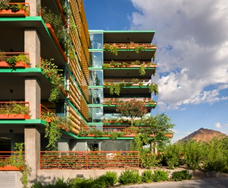
What emerged from that founding conviction is an architectural language that is unmistakably Optima, and nowhere in the Arizona portfolio is it more fully expressed than at Optima Sonoran Village. The vertical landscaping system that allows plants to grow at the edge of every floor, turning the building into something living and seasonal. The 6.1 acres of open space and lushly landscaped courtyards that make a ten-acre community feel like a genuine oasis in the heart of Old Town Scottsdale. The floor-to-ceiling windows and open floor plans that blur the boundary between inside and out. The sculpture garden, five original David Hovey Sr. FAIA, works in natural Cor-Ten steel, placed so that art is encountered on the way to the pool, not the other way around. None of these are finishing touches. They are the architecture.

Designing With Nature, Not Against It
The expansion into Arizona beginning in 2000 was as much a design opportunity as a market decision. David Hovey Jr. describes the desert as a laboratory, a place to test modernist principles against an extreme climate, to learn how steel, concrete, high-performance glazing, shading devices, and native desert landscaping perform when pushed by heat and light. Optima Sonoran Village was the fullest early expression of that learning: a community that uses perforated panels, louvers, and a vertical landscaping system to mitigate the harsh desert climate while creating an environment of extraordinary beauty. The influence of Frank Lloyd Wright’s Taliesin West, the conviction that architecture must understand and respond to its specific landscape, is visible in every design decision here.
A Living Legacy
The Optima design legacy is also a living one. David Hovey Jr. has deepened the firm’s commitment to sustainability across every subsequent community, while Tara Hovey has ensured the strength of the long-term relationships that make the work possible. Together, the Hovey family has built something rare: a design firm whose founding principles, integration, quality, nature, and the belief that architecture is one of the most powerful forces for human good, are as present today as they were when Optima began.
The Legacy You Live In
You don’t need to know architectural history to feel the difference when you walk into Optima Sonoran Village. You feel it in the light through the floor-to-ceiling windows, in the greenery that cascades from every floor, in the sense that every detail was considered by people who cared deeply about getting it right. That is the Optima design legacy, and it lives in every room.
Experience a design legacy in person. Schedule a tour at Optima Sonoran Village today.


Latest Articles

The Architects Behind the Vision: A Look at Optima’s Design Legacy

Living Alongside Art: How Sculpture Transforms a Community
